
Document Types in CLM

Document Types classify and identify the purpose of documents stored within the contract repository.
🗺️ Overview
Each document type defines the nature of a file — such as whether it is an NDA, Statement of Work (SOW), Main Agreement, or another standard legal or commercial document.
Document Types are system-defined and cannot be added, edited, or removed.
There are currently 36 predefined document types available across the platform.
🧑🦱 Who Can Use This
All users with editing permissions to specific contract, CLM Power Users can upload and assign document type to an uploaded document.

💡 Note: Document Types are only available if you have sufficient rights to be able to upload documents to the document repository on contract level. If you do not have rights, contact your administrator.
💻 Document Type Sections
Assigning a Document Type ensures consistency and improves searchability, reporting, and compliance tracking.
It allows users to quickly identify what kind of document is attached to a contract and supports automated classification in integrations and workflows in future.
Using standard document types helps:
📁 Organize large contract repositories efficiently
🔍 Improve document search and filtering
📊 Support analytics and reporting by document category
🔗 Enable integration mappings with external systems (e.g., CLM, ERP, DMS)
⚙️ How It Works
Each time a document is uploaded to a contract, users can select a Document Type from a predefined list.
This list includes 36 system-defined options, such as:
Master Agreement, NDA, Statement of Work (SOW), Addendum, Price List, Appendix, and others.
🪟 Selecting a Document Type
Navigate to Contracts → Documents.
Click Upload Document or select an existing document from the repository.
In the Type dropdown, start typing to search or scroll to select from the available list.
Once selected, the document is automatically categorized under that type.
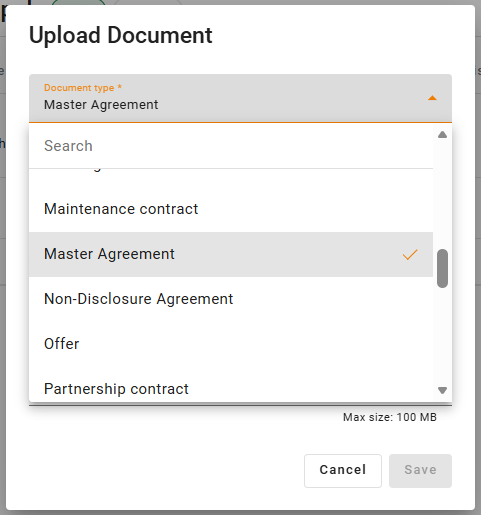
💡 Tip: The dropdown field supports search functionality — you can quickly find the correct document type by typing part of its name.
Document Type | Description |
Temporary Labour contract | A contract between a temporary worker, a temporary staffing agency (or employment agency), and sometimes a client company. It outlines the terms and conditions of a temporary employment assignment. |
Statement of Work | A contract that clearly defines the work activities, deliverables, and timeline a vendor or service provider must execute in performance of specified services to the client. It's a detailed narrative description of the work requirements for a project. |
Rental contract | A legally binding contract between a landlord (or property owner) and a tenant that outlines the terms and conditions under which the tenant can occupy and use a property for a specific period. It specifies the rights and responsibilities of both parties. |
Purchasing contract | A legally binding contract between a buyer and a seller that outlines the terms and conditions for the purchase of goods or services. It specifies the details of the transaction, ensuring that both parties understand their rights and obligations. |
Partnership contract | A legally binding contract between two or more individuals or entities who agree to operate a business together as partners. It outlines the terms and conditions of their partnership, including each partner's contributions, responsibilities, and profit‑sharing arrangements. |
Non-Disclosure Agreement | A legally binding contract between two or more parties that outlines confidential material, knowledge, or information that the parties wish to share with one another for certain purposes but restrict access to by third parties. |
Maintenance contract | A contract between a service provider and a client that outlines the terms and conditions for regular maintenance of a product, system, or property. It ensures that the asset remains in good working condition and helps to prevent breakdowns or failures. |
Master Agreement | A foundational contract that sets out the general terms and conditions governing future transactions between two parties. It's designed to streamline the process of entering into multiple agreements by establishing a framework that applies to all subsequent deals. |
Loan Agreement | A legally binding contract between a lender and a borrower that outlines the terms and conditions of a loan. It specifies the amount of money borrowed, the interest rate, the repayment schedule, and other important details. |
License Agreement | A legal contract between two parties, the licensor and the licensee, where the licensor grants the licensee permission to use a specific asset, such as intellectual property, technology, or software, under defined terms and conditions. |
Leasing contract | A legally binding contract that grants one party (the lessee) the right to use an asset owned by another party (the lessor) for a specified period in exchange for periodic payments. |
Insurance | A legally binding agreement between an insurer (insurance company) and an insured (individual or entity). It outlines the terms and conditions under which the insurer agrees to provide financial protection to the insured against specified risks or losses. |
Hosting contract | A legally binding contract between a hosting provider and a client that outlines the terms and conditions of providing website or application hosting services. It defines the responsibilities, rights, and obligations of both parties. |
Franchise contract | A legally binding contract between a franchisor and a franchisee. It grants the franchisee the right to operate a business using the franchisor's established brand, trademarks, systems, and processes, in exchange for fees and adherence to specific standards. |
Data Processing Agreement | A legally binding contract between a data controller and a data processor. It outlines the responsibilities of the data processor in handling personal data on behalf of the data controller, ensuring compliance with data‑protection laws like the GDPR. |
Contractor Agreement | A legally binding contract that outlines the terms and conditions between a business and a contractor for a specific project or service. The primary purpose of this contract is to establish a clear understanding of the work arrangement and ensure that the independent contractor is not considered an employee of the business. It establishes the rights and responsibilities of each party involved. |
Construction contract | A legally binding contract between two or more parties that outlines the terms and conditions for a construction project. It details the responsibilities, rights, and obligations of each party involved. |
Addendum | An attachment to a contract that modifies the terms and conditions (or part of) of the original contract. It is used to update, clarify, or nullify a portion of the original document |
Additional information | Documents that provide supplementary or contextual information related to the contract but do not fit into other defined document types. These documents support understanding of the agreement without forming part of the core contractual or commercial terms. |
Certificate | Official documents of organizational achievements or compliance issued by recognized bodies that verify an organization's adherence to established standards, regulations, or its attainment of specific goals. These certificates serve as tangible proof of an organization's commitment to quality, safety, ethical practices, or other relevant criteria |
Code of Conduct | A set of guidelines and principles that outline the expected behaviors and ethical standards for members of an organization and for its business partners. It serves to promote integrity, accountability, and professionalism, ensuring that all individuals act in accordance with the organization's values and policies. |
Financial documentation | Serves to provide concrete evidence and clarification of the financial aspects of an agreement. This can encompass a range of documents, all aimed at ensuring transparency and preventing financial disputes. |
General Terms & Conditions | A standardized set of legal provisions, typically presented as a separate document or accessible via a website, that govern the relationship between a business and its customers or clients. They outline the fundamental rights, obligations, and responsibilities of each party, covering aspects such as payment terms, delivery, warranties, liability, dispute resolution, and intellectual property rights, among others. GTCs aim to provide a consistent and efficient framework for conducting business, reducing the need for individual contract negotiations for each transaction. |
Information Security Requirements | A formal agreement between two organizations about how sensitive data will be handled and protected. |
Insurance Certificates | Is an essential document that serves as proof of insurance coverage. |
Offer | Documents that contain the commercial offer or proposal that forms the basis of the agreement. These documents usually define pricing, conditions, and terms proposed before the contract is signed. |
Pricing terms | A structured list that outlines the general or client specific prices of a company's products or services. It may include quantities, unit prices, total amounts, (volume) discounts and further information. |
Product information | Documents that describe the products or services covered by the contract. This document provides specifications, features, scope, or technical details that support the commercial agreement. |
Risk documentation | Documents which are used to assess, document, or mitigate legal, financial, operational, or compliance risks related to the contract. |
Service Description | Defines the scope, nature, and specifications of the services that one party (the service provider) will provide to the other party (the customer). It acts as a precise and unambiguous outline of what is being delivered, minimizing misunderstandings and disputes |
Service Level Agreement | An agreement that defines the level of service expected by a customer from a service provider. It lays out the metrics by which that service is measured, as well as remedies or penalties should agreed-upon service levels not be achieved |
Sideletter | A separate, supplementary document that modifies, clarifies, or adds to the terms of the main contract. It's used to address specific issues or agreements that weren't included in the original contract or to make changes without formally amending the entire contract. |
Specific certificate | Documents that certify compliance with specific standards, regulations, or contractual requirements related to the contract. |
Technical Specifications | A detailed description of the technical requirements, characteristics, and performance standards that a product, system, or service must meet. They are crucial for ensuring that both parties have a clear and mutual understanding of what is being delivered |
Terms of Use | Legal rules that users must agree to in order to use a website, app, or other online service. Essentially, they form a contract between the service provider and the user or organization |
Warranties & Guarantees | Provide assurances about the quality, performance, and reliability of goods or services. |
Document Types are fixed system values and are consistent across all environments.
Administrators and end-users cannot modify or create new Document Types.
The selection of the correct type is crucial for accurate reporting and automated processing.